Monday, March 24, 2014

Monday, March 10, 2014
Blog Post 3: Sonic Devices (Due 3/12-3/13)
“Williams, as it happens, also lets the vowel of age chime with another word: glaze, which has the same end consonant sound as trees. Later, broken shares a vowel with snow and a consonant with covered and seedhusks—well, it's clumsy work, trying to trace these audible subtleties. I'll just point to the beauty of "the flock has rested,/ the snow/ is covered with broken/ seedhusks"—without trying to describe any further what we hear: The hearing itself is an action of consciousness, a kind of awakening and of keeping.” -Robert Pinsky, from Slate.com
In this commentary, the poet Robert Pinsky remarks on William Carlos Williams’ ability to create a sonically pleasing piece of poetry written entirely in blank verse: that is to say, a poem devoid of end-rhyme. After reading the poem (below) discuss the following:
How has W.C. Williams used language to create interesting sounds? What does this add to the text? Do sonic devices contribute to meaning, or are they parallel to it?
Finally, try to write a sentence that could be used in your personal narrative which employs similar techniques!
"To Waken an Old Lady" by W.C. Williams
Old age is
a flight of small
cheeping birds
skimming
bare trees
above a snow glaze.
Gaining and failing
they are buffeted
by a dark wind—
But what?
On harsh weedstalks
the flock has rested,
the snow
is covered with broken
seedhusks
and the wind tempered
by a shrill
piping of plenty.
Wednesday, March 5, 2014
Improving Your Personal Narrative #2 (Due Friday, 3/7)
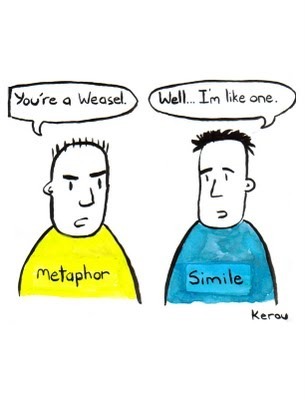
Effectively employing simile and metaphor can be a challenge for any writer. Cliche or obscure attempts can fall flat, leaving readers disheveled and as a result, disinterested. That being said, a quality simile or metaphor can enhance writing immensely. The following poem, by Pablo Neruda, uses copious amounts of figurative language in an effort to depict the speaker’s love for words. In your response, please identify:
-One simile
-One metaphor
Upon completion, write one of each, to be used in your personal narrative. If you chose either simile or metaphor for the last blog post, please provide a different example in response to Neruda’s work. Attempt to avoid cliche or overly obscure comparisons; use the Pablo Neruda poem for guidance!
You can say anything you want, yessir, but it's the words that sing, they soar and descend . . . I bow to them . . . I love them, I cling to them, I run them down, I bite into them, I melt them down . . . I love words so much . . . The unexpected ones . . . The ones I wait for greedily or stalk until, suddenly, they drop . . . Vowels I love . . . They glitter like colored stones, they leap like silver fish, they are foam, thread, metal, dew . . . I run after certain words . . . They are so beautiful that I want to fit them all into my poem . . . I catch them in mid flight, as they buzz past, I trap them, clean them, peel them, I set myself in front of the dish, they have a crystalline texture to me, vibrant, ivory, vegetable, oily, like fruit, like algae, like agates, like olives . . . And I stir them, I shake them, I drink them, I gulp them down, I mash them, I garnish them, I let them go . . . I leave them in my poem like stalactites, like slivers of polished wood, like coals, pickings from a shipwreck, gifts from the waves . . . Everything exists in the word . . .
|
From Memoirs by Pablo Neruda (NY: Penguin, 1974), p. 53.
|
Monday, March 3, 2014
Improving Your Personal Narrative (Due 3/5 or 3/6)
The following poem, "After a Death," by the Swedish poet Tomas Transtromer, utilizes multiple pieces of figurative language and a handful of sonic devices to vividly depict life after a death. Please choose one facet of this poem that interests you and write a three to five sentence response discussing how you might incorporate this technique in your personal narrative. Finally, write an example of a sentence (or group of sentences) that makes use of the specific device you have discussed, in the context of your personal narrative. Feel free to offer respectful feedback to your peers!
For example:
If I decided to focus on personification, I might discuss how Transtromer compares a shadow to a man standing beside an "armor of black dragon scales." I would then attempt to use personification in my personal narrative, and include it as part of my post.

After a Death
For example:
If I decided to focus on personification, I might discuss how Transtromer compares a shadow to a man standing beside an "armor of black dragon scales." I would then attempt to use personification in my personal narrative, and include it as part of my post.

Once there was a shock
that left behind a long, shimmering comet tail.
It keeps us inside. It makes the TV pictures snowy.
It settles in cold drops on the telephone wires.

One can still go slowly on skis in the winter sun
through brush where a few leaves hang on.
They resemble pages torn from old telephone directories.
Names swallowed by the cold.

It is still beautiful to hear the heart beat
but often the shadow seems more real than the body.
The samurai looks insignificant
beside his armor of black dragon scales.
Subscribe to:
Posts (Atom)